My article published today in the ASOR Newsletter:
http://asorblog.org/2017/05/23/israel-numismatic-report-important-finds-altruistic-reporting-law/

Holy Land Numismatics and Archaeology
Thursday, May 25, 2017

Monday, March 14, 2016
Finding Bar Kokhba Coins in Kentucky (or NOT)
In the last few weeks, I have been
preparing a gift of my personal coin collection to the American Numismatic
Society. Among the coins was a fascinating piece that is an exact twin to one
of the most notorious incidences of numismatic fraud—either actual or
accidental— that has occurred in the United States. This story continues to be
circulated, and I receive questions about the Bar Kokhba coins found in
Kentucky on a regular basis.
Here is the
background….1952, Robert Cox, a hardware store operator from Clay City,
Kentucky, found an exotic coin in a pen he was using for pigs just outside of
town along Kentucky Highway 15. The pig
pen was part of a field that he had plowed the summer before. It was the first
time older residents of the city could remember that this land had ever been
turned over. He seemed an honorable man and had nothing to do with ancient
coins, and it appears that Mr. Cox legitimately found the coin just where he
said he found it.
Clay
city is about 40 miles east of Lexington, Kentucky. Equally fascinating is that
two other Bar Kokhba coins were discovered in different Kentucky towns.
The
rest of the story involves a number of well known scholars who refused to
believe other expert numismatists, and has such a long history that it is often
repeated as a “true story” today.
It is related quite
specifically by celebrated archaeologist Dr. Cyrus Gordon (who taught at
Dropsie College, Brandeis University, and New York University) in his 1971 book
Before Columbus: Links Between the Old World and Ancient America:
“Other
contacts with the Roman Mediterranean of the second century AD have meanwhile
come to light in Kentucky, where inscribed Hebrew coins of Bar Kokhba’s
rebellion against Rome were dug up in Louisville, Hopkinsville, and Clay City.
The assorted coins were found at different times and in widely separated areas:
at Louisville in 1932, at Clay City in 1952, and Hopkinsville in 1967. These
coins have been examined and identified by Professor Israel T. Naamani of the
University of Louisville. There is no difficulty in identifying these Bar Kokhba
coins. The Clay City coin was sent to the late Professor Ralph Marcus of the
University of Chicago who had no trouble in reading “Simon”, Bar Kokhba’s
personal name, on one side, and “Year 2 of the Freedom of Israel” on the other
side.”
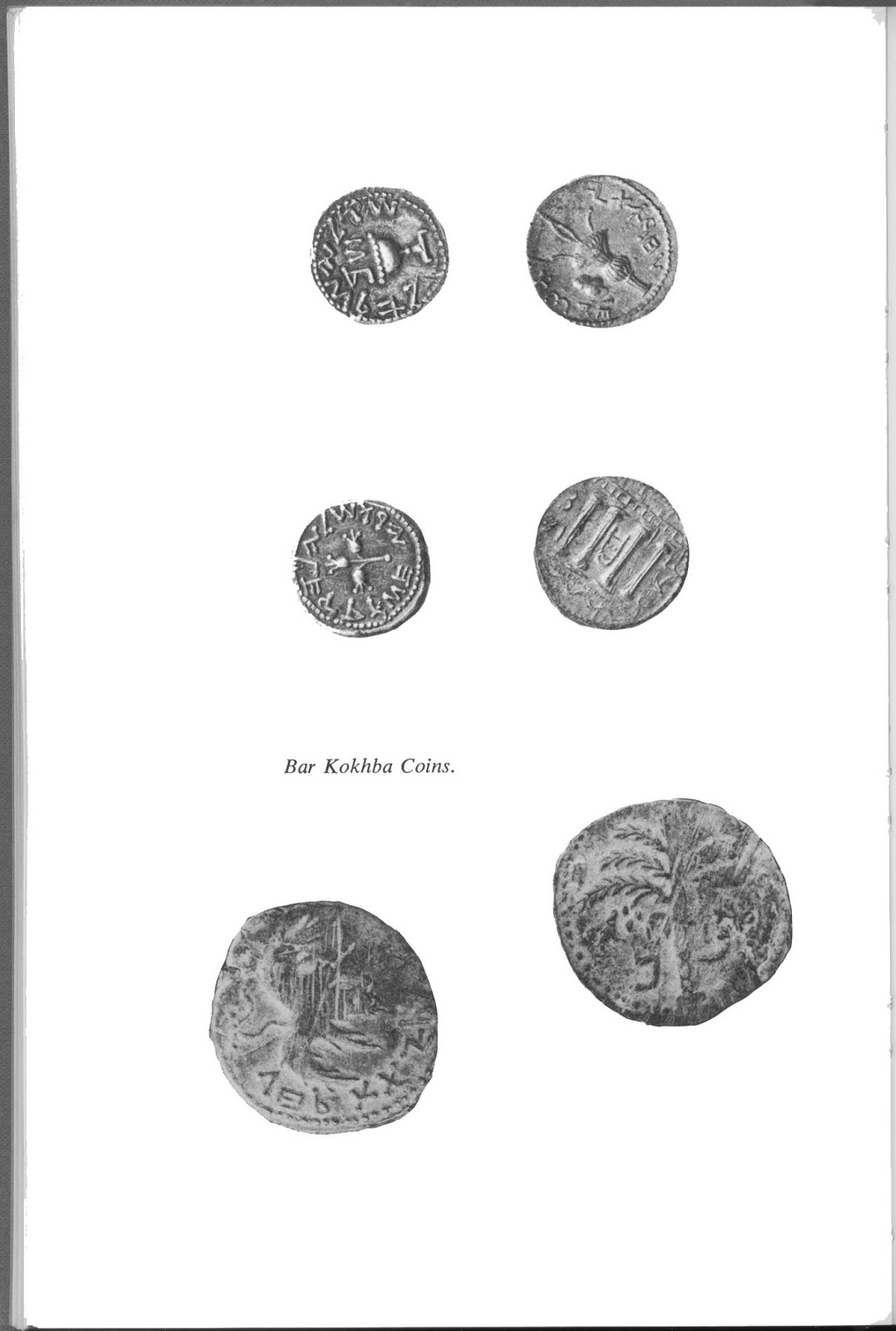
Copy
of misleading page from Cyrus Gordon’s book Before
Columbus, suggesting that these are genuine Bar Kokhba coins that had been
found in Kentucky when in fact only fantasy replicas were found. Also note that
Prof. Gordon incorrectly identifies a shekel of the Jewish War (first and
second row left) as a Bar Kokhba coin! (photo from Not Kosher by David Hendin).
Professor
Gordon amazingly seems to have drawn his information from a number of articles
in Kentucky newspapers, which reported on these rather astonishing discoveries.

Opening
of article published in the Louisville, KY, Courier-Journal, July 12, 1953. It
is quite simple for even a beginner to identify this as a “fantasy replica” of
a Bar Kokhba coin (from NOT KOSHER by
David Hendin).
In 1978 a
University of Texas anthropologist named Jeremiah Epstein published a paper. In
the course of his research he sent a photocopy of the Clay City coin to Prof. Ya’akov
Meshorer, then curator of numismatics at The Israel Museum, Jerusalem.
One
would think that the opinion about this coin by Ya’akov Meshorer, surely the
world’s leading expert on ancient Jewish coins at the time) would end the
discussion. And for Professor Epstein, it did. However, according to Epstein,
his correspondence with Professor Naamani indicated that “Naamani continues to
accept Marcus’s judgement.” In other words, he believed that Professor Marcus
was correct and Professor Meshorer was incorrect.
In
comments on Epstein’s article, in the journal where it was published, Professor
Warren L. Cook of the Castleton State College in Vermont wrote: “Meshorer’s labeling a Kentucky Bar Kokhba
coin a forgery on the basis of a photo-copied newspaper article illustration is
unconvincing, yet Epstein is ready to condemn similar coins on such authority.”
Almost
15 years ago Haim Gitler, current chief curator of archaeology and curator of numismatics
at The Israel Museum, and I both received communications from Dr. Fred Coy Jr.,
an economist at Ohio State University.
Dr.
Coy sent us photographs of the actual Clay City coin discovered in 1952 by
Robert Cox. He told us that a man named
Ya’akov Meshorer had said it was fake back in 1978. But he wanted to check this
information to make certain that Meshorer knew what he was talking about.

Coin
exactly identical to the Clay City coin found by Robert Cox (“authenticated” by
professors at the University of Louisville and the University of Chicago). It
is part of the collection I will be donating to the American Numismatic Society
later this year (photo: David Hendin).
Gitler
and I both immediately agreed with Meshorer and stated that this coin was a
fake, not even a forgery, but a kind of a fantasy copy.
Professor
Coy, who is not a numismatist, kept asking me WHY this coin was not a genuine
ancient coin. I’m afraid that I did not
have much patience, and I kept saying, “it is FAKE because it is NOT
GENUINE. It is NOT even close and
therefore does not justify further discussion.” But he was insistent and went
to other sources and concluded, finally, and correctly that the coin is not
genuine because:
èThere
can be a cross or a rosette over the Temple on the obverse, but not a 6-pointed
Star of David. The latter is strictly for the tourist trade.
èThe
shin and mem from the beginning of Simon’s name are entirely
missing from the obverse side, even though the adjacent dots are present,
indicating that the missing letters could not have been just worn off. This
looks like someone copied from a worn coin that was missing these letters, but
then added the dots to make the replica look more complete.
èLikewise,
a stroke is missing from the bet, and the het is made as if it
were a B.
èA
tetradrachm of this type should be silver, but this coin is bronze.
èThe
lulav is badly made. Also, the etrog has been reduced to a mere blob to the
right of the lulav.
èThere
is no sign of an obliterated Roman coin under the image, even though this
should be evident.
èHe
forgot to mention that by no stretch of anyone’s imagination could this be an
ancient coin!

An
authentic sela or tetradrachm of Bar Kokhba struck in the second year of the
revolt, 133/134 AD (photo:David Hendin)
These
observations are second nature to anybody who has ever seriously studied Bar Kokhba
coins. But here I have discussed a parade of esteemed University Professors who
have been bickering back and forth about this coin since it was discovered in
1952. And we have also learned that the other
two so-called Bar Kokhba coins from Kentucky are of the exact type as this one.
A photograph accompanying this article depicts an exact duplicate of the coin
found in Louisville in 1967. The same
Professor Israel T. Naamani of the University of Louisville examined this
coin. Astoundingly, he pronounced it
similar to the Clay City coin, “But this one is much more genuine. The Jews
were not strong after the rebellion; so what did they do? They took Roman coins
and re-minted them. Underneath if you scratch them there are Roman
inscriptions.” (Scratching a coin is certainly NOT the way to observe any
overstruck coin….)
He
added that farmer Coy’s Clay City coin was a “Roman re-mint, but Bray’s was
newly minted 1,832 years ago.”
Oh,
dear. Maybe college professors ought to be forced to get licenses before
commenting on subjects about which they are completely in the dark.
My
research at the British Museum has uncovered a lead cast of this very type of
Bar Kokhba fake, which was presented to The British Museum in 1922 by Spink and
Sons as a replica. Therefore, the
original must be somewhat older than that.
My
best bet is that this was a souvenir given away by a Bible marketing company in
the early 1900s and hundreds or even thousands were passed through the American
South. I have personally seen more than 50
of them.
The
stories around these coins represent wishful thinking by American Bible Belt
scholars. Wouldn’t it just be so interesting if the people in the United States
were directly descended from Jews who came to our shores not long after the time
of Jesus….sigh.
But
it isn’t so and I am glad to report this story over and over to remind
collectors that the authenticity of a coin that has not been found in a
licensed archaeological excavation is only as good as the expert who is
evaluating it!
(This
blog is adapted from my book NOT KOSHER,
Forgeries of Ancient Jewish and Biblical Coins, New York, 2005.)
Monday, March 7, 2016
The Coin in the Fish’s Mouth
Jesus, as a practicing Jew, was
aware of his annual financial obligation to the Jerusalem Temple. This annual
tribute is nicely illustrated in the parable of the coin in the fish’s mouth.
Each year, Jewish officials
requested that the annual Temple contribution at the beginning of the Hebrew
month of Adar, preceding Passover. On the fifteenth day of Adar, tables of the
money changers were set up through the Holy Land to receive these
contributions. Talmudic traditions mention various cities in Galilee where
lists of those who had given were gathered and transferred to Jerusalem.
After 10 days, on the twenty-fifth
of Adar, the money-changers terminated their local collections and continued
their operations only in the immediate area of the Jerusalem Temple.
Virtually all Jews, including
those who had expressed reservations about the current state of the Temple and
its system of sacrifices, also sent their contributions to the Temple. Matthew
17:24-27 (NIV) tells the story of how Jesus and his disciples were solicited
and gave their contribution to the collectors of the Temple tribute:
24 After Jesus and
his disciples arrived in Capernaum, the collectors of the two-drachma temple
tax came to Peter and
asked, “Doesn’t your teacher pay the temple tax?”
25 “Yes, he does,” he
replied.
When Peter came into the house, Jesus was the
first to speak. “What
do you think, Simon?” he
asked. “From whom do the
kings of the earth collect duty and taxes—from their own children or from
others?”
26 “From others,”
Peter answered.
“Then the children are exempt,” Jesus said to him. 27 “But so that we
may not cause offense, go to
the lake and throw out your line. Take the first fish you catch; open its mouth
and you will find a four-drachma coin. Take it and give it to them for my tax
and yours.”
This
story of the coin in the fish’s mouth is never verified beyond this telling—in
other words, we don’t know if this is a true story, partially true, based on a
legend, or a parable intended to otherwise enlighten readers. If a coin really
was found in a fish’s mouth, however, it seems clear from Matthew’s report that
it would have been a shekel of Tyre since that was the singular coin accepted
as payment of the annual half-shekel Temple tribute for both Jesus and for
Peter the fisherman.
Shekels and half-shekels of Tyre (together with fewer Seleucid tetradrachms and didrachms often struck in Tyre, Sidon, or Antioch) were certainly
the most commonly circulated silver coins in the ancient Holy Land from the
first century BC to the time of the Jewish War Against Rome, which ended in 70 AD.

Tyre shekel struck 103/102 BC at Tyre. The
obverse depicts the god Melquart, a Tyrian version of Herakles, and the reverse
depicts an eagle with a club to left, the club is a mintmark of Tyre. The reverse
inscription, in Greek, contains the date, and proclaims, “[money of] Tyre, the
Holy and Inviolable.” (photo courtesy cngcoins.com)
It is also known, as discussed
above, that during this period, the Tyre silver shekels and half-shekels
were the only coins accepted as payment of the annual tribute to the
Jerusalem Temple of one half shekel per Jewish adult male.
Ya’akov Meshorer theorizes that
there were two basic issues of Tyrian silver coins. The first issue was struck
in Tyre from 126/5 BC until 19/18 BC and the second issue was struck in or near
Jerusalem, from 18/17 BC until 79/60 AD. This is possible, though other
numismatists have argued that the second issue, which is cruder in style and
manufacture than the first, may not have been minted at Tyre, but was probably
minted somewhere other than Jerusalem.

Tyre shekel minted during the life of Jesus,
in 10/11 AD. Meshorer believed that the Tyre shekels and half-shekels
minted after 18/17 BC were struck in Jerusalem. Others believe that the coins
may not have been minted at Tyre, but were probably not struck in Jerusalem.
(photo by David Hendin)
Whether struck in Tyre or farther
south, it is clear that the silver coins of ancient Tyre were well known in the
ancient world for their weight and quality of silver. The Talmud makes it a point to explain that
“Silver, whenever mentioned in the Pentateuch, is Tyrian silver.” (Tosephta
Kethuboth 13,20)
Because of
this quotation, backed up by the obviously large quantity of the coins
originally minted, it is quite clear that many New Testament stories, such as
the coin in the fish’s mouth mentioned above, the 30 pieces of silver paid to
Judas for his betrayal of Jesus (Matthew 26: 14-15), and the large silver coins
used to bribe the soldiers who had fled from their watch at the Holy Sepulcher
on Easter morning (Matthew 28:11) each most likely involved the shekels and the half-shekels of Tyre.
Monday, February 22, 2016
St. Helena, the First Christian Pilgrim
On a visit to Rome, we sought out the church of Santa Croce in
Gerusalemme. My American Express Guide to Rome (long out of print, but still handy)
says it was “One of the seven pilgrim churches of Rome, it is said to have been
built to house the precious relics of the True Cross brought to Rome from
Jerusalem by St. Helena, the mother of Constantine.”

Santa Croce in
Gerusalemme (photo: Commons.Wikimedia.org)
It is said that Helena founded the
church on land where her private palace stood. Although it was on the edgte of
the city, the relics of the crucifixion of Jesus Christ that Helena brought back from Jerusalem made Santa
Croce in Gerusalemme a center for pilgrimage. Most important were some pieces of Christ’s
Cross (croce means “cross”) and part
of Pontius Pilate’s inscription, called the Titulus Crucis, proclaiming “Jesus
of Nazareth King of the Jews,” written in Latin, Hebrew and Greek. There is
little doubt that this wooden plaque is very old, but numerous tests performed
over the years have never established its authenticity absolutely.
Nevertheless, even to a non-Christian observer, it is quite moving to view
these relics.

.
When we
entered the church, only a few days after Easter, we seemed to be the only
visitors. We walked up to the altar and
around the chapel. We did not see any relics, so we made our way into the
smaller side rooms and found them in a small room behind the main altar. Here we saw St. Helena’s relics: three pieces
of wood set in a larger cross; they are said to be actual pieces of the True
Cross. Two thorns, said to be from
Jesus’ crown of thorns are mounted and stand alongside it, as does a piece of a
bronze nail, said to be from the crucifixion itself. And finally, we saw the piece of wood that is
said to be from the sign Pontius Pilate was said to have erected over Jesus
while he was crucified.
Whether or
not they are authentic relics, I cannot say.
But seeing them was a fascinating experience.
It led me
to recall the importance of Helena ,
later revered as St. Helena , to the ancient land of Israel Constantine .

Constantius I Chlorus
follis (307/310-337), father of
Constantine I, first husband of Helena (photo: cngcoins.com)
In 292,
when Constantius became Caesar of Spain, Gaul
and Britain ,
he dumped Helena
and married Theodora, the daughter of Maximian, his patron.

Theodora, died before
337 AD, follies (photo: cngcoins.com)
Meanwhile, Helena’s son Constantine
became a soldier, and spent a lot of time at Diocletian’s court. When Constantine
persuaded the Roman legions in Britain
to proclaim him Caesar in 306, he immediately called for his mother and
installed her in his court with the appropriate honors befitting the mother of
the Emperor.

Constantine I bronze
struck at Constantinople. The reverse depicts a labarum crowned by a
Christogram, piercing a serpent, with the legend SPES PVBLIC (hope for the
public). Constantine saw the Christogram in a vision and also began to wear it
on his helmet and shield (photo: cngcoins.com)
In 312, the
most significant event of Constantine ’s
reign occurred. While preparing for a battle with the army of his rival
Maxentius at the Milvian Bridge in Rome, he saw a cross in the sky with the
inscription IN HOC SIGNO VINCES (“In this sign you will conquer”). He immediately ordered his troops to paint
the monogram of Jesus, the labarum, on their shields and this extra strength
enabled their victory and gave Constantine
control of the West as well as the East, whereupon Constantine vowed to make the Roman Empire a Christian nation.

Vetranio bronze (c.
350 AD) struck under Constantius II (337 – 361 AD) as Siscia. The reverse
legend is HOC SIGNO VICTORERIS (In this sign, you will conquer). The scene and
legend on this coin provide a re-enactment of Constantine I’s victory at the
Milvian Bridge. (photo: cngcoins.com_
In 324 AD
Constantine named Helena as “Augusta,” a title that was established by Augustus
for Livia, but certainly not granted every empress, much less every royal
mother.

Helena as Augusta 324-328/30, bronze follis (photo:
cngcoins.com)
In 325 AD,
the Council of Nicea met and Constantine
declared Christianity to be the nation’s official religion. Incidentally, it is
not clear whether Constantine himself actually ever became a Christian. His mother, Helena, was not only converted
but was so excited by her spiritual experience that it enticed her to make a
pilgrimage, circa 326 AD to Judea, where she could visit all of the sites that
were important in the life of Jesus. She was in her late 70s at the time she
embarked. Helena’s pilgrimage was the prototype for the travels of virtually
every Christian pilgrim to the Holy Land for some 1,700 years, right up to
today.
Until Helena’s
visit, nobody outside of the Christians in the Holy Land had paid much
attention to the sites there. In
Helena’s day the Jews maintained important academies at Tiberius, Sepphoris,
and Lydda (Lod). Led by Rabbi Yehudah
Ha’Nassi the Jewish scholars were in the final stages of developing the Talmud
itself. When I was the numismatist at
the Joint Sepphoris Expedition in 1985 and 1986, led by Duke’s Eric and Carol
Meyers and Hebrew University’s Ehud Netzer, we discovered some remarkable
mosaic floors—and many more were subsequently discovered at Sepphoris—which
indicated that the city was extremely wealthy at the time Helena arrived in the
country. In fact, we dated some of these mosaics by small groups of
Constantinian coins lying on top of and just under them.
While there
is no doubt that the local traditions held some, or perhaps many of the sites
Helena visited as holy shrines, it did not hurt that the mother of the Emperor
of Christian Rome further declared the sites to be true.
And indeed,
Helena was said
to have:
--Proclaimed
the actual path Jesus took on his way to the cross, the Via Dolorosa, and
declared the precise spots of all of the fourteen Stations of the Cross;


Fifth Station of the
Cross (top) and the Via Dolorosa in the Old City of Jerusalem. (photos: David
Hendin)
--Found at
least several pieces of the true cross itself;
--Identified
the spot near the Sea of Galilee where the
miracle of fish and loaves occurred;
--Confirmed
the place where Jesus stood when he gave his Sermon on the Mount;
--Marked
the place of the Annunciation, where Mary learned that she would give birth to
Jesus;
--And she
also identified places where Joseph’s carpentry shop stood, where Jesus was
born, the field in which the shepherds saw the Bethlehem Star, and the inn of
the Good Samaritan.
The story
of Helena ’s
pilgrimage is certainly not fantasy. In
his Life of Constantine (c. 340 AD),
Eusebius wrote (only about ten years after her death) that Helena lavished good
deeds on the Holy Land, and “Although well advanced in years, she came, fired
by youthful fervor, in order to know this land” and she “explored it with
remarkable discernment …And by her endless admiration for the footsteps of the
Savior…she granted those who came after her the fruits of her piety. Afterward
she built two houses of prayer to the God she revered, one in the Grotto of the
Nativity (this is the Church of the Nativity in Bethlehem ) and the other on the Mount of the
Ascension (this is the Eleona
Church Mount of Olives ).” Helena
also is said to have identified the spot where Jesus was crucified and buried,
and ordered the first Church of the Holy Sepulcher to be built there.
It is a
matter of some interest that while Helena ’s
important pilgrimage is well documented, not a single numismatic memento of
these events was issued. So the coins of Helena
can only offer us a glimpse of the appearance of this important woman of
antiquity.
Friday, February 12, 2016
War of Quietus--Another Jewish Revolt
There was a
significant “Third Revolt” of the Jews during the reign of the emperor Trajan
(98-117 AD). This war took place between
the Jewish War (First Revolt—66-70 AD) and the Bar Kokhba War (Second Revolt—132-135
AD).
It was
called “the war of Quietus” and took place between the years 115 and 117 AD. It was fought in Cyrenaica, Cyprus, Egypt,
and Mesopotamia, but apparently not in Judaea.
More
accurately, the “war of Quietus” was a series of revolts. These revolts were likely the direct results
of both the aftermath of the reign of Domitian (who was especially hard on
Christians and Jews) as well as attacks under Trajan’s rule on both Christian and
Jewish leaders.
We do not know a great deal about
the “war of Quietus,” and one reason is that there is not any known numismatic
material that references this war. By
comparison, the numismatic evidence from the First Revolt consists of both the
coins of the Jews of the period, as well as the JUDAEA CAPTA coins of the
Flavians, which reflect a great deal on their view of Rome’s victory.
Bar Kokhba’s
coins are likewise very important to our knowledge of the so-called Second
Revolt. Indeed, the first name of Bar Kokhba,
“Simon” was known ONLY from his coins until forty years ago—1960 to be
exact—when the Bar Kokhba letters, discovered in caves near the Dead Sea, were discovered
and translated.

Bar Kokhba bronze coin with the name
of Simon. (Image © by David Hendin)
After
Domitian’s harsh rule, his successor, Nerva, was less abusive to his subjects.
There is no
doubt that at this time in history there was quite a lot of animosity against
the Jews. If you don’t believe it, read
the very anti-Jewish first-century historian Tacitus, who in small part stated:
“The other practices of the Jews are sinister and revolting, and have
entrenched themselves by their very wickedness.”
Early in
the second century, under Trajan’s rule, the head of the Judaeo-Christian
Church, Simeon, son of Cleophas, was executed by the Roman governor of Judaea.
Furthermore, Ignatius, bishop of
Antioch, a leading gentile Christian, was sent to Rome and executed about the
year 110. Grant describes him as “the
first significant Christian churchman.”
(At this point in the history of Christianity there were both Jewish
Christians and Gentile Christians. Originally
Christianity was an offshoot of Judaism, thus the earliest Christians needed
first to be Jews. Later, as Paul spread the
gospel throughout the world, he preached that non-Jews could convert directly
to Christianity without becoming Jewish first.)
The reasons for these executions
are not clear, but they are probably part of a religious persecution by Rome that also
underscored the Jewish unrest.
In 110, Trajan moved against Parthia , thus
ending a 50-year peace that Nero had established. The Parthians had been weakened by the new
and powerful Kushan kingdom in eastern Iran . A few years later, Trajan also annexed Armenia , and
moved his armies into upper Mesopotamia and
Adiabene. Adiabene is a country of
special interest, since its ruling dynasty (led by Queen Helena) had voluntary
converted to Judaism in the first century.
(Helena’s tomb stands today in East Jerusalem, it is known as the “Tomb
of the Kings…a blog on Queen Helena of
Adiabene at a later date.)
During these various military
operations, a large number of Jewish communities came under Trajan’s control.
The first uprising came in Cyrenaica , where a Jewish king named Lukuas (also called
Andrew) violently attacked the local Greek governments and Roman provincial
authorities—all of whom had been weakened in favor of Trajan’s Parthian
campaigns. Cassius Dio painted a grim
picture of Jewish atrocities, culminating with the Jews forcing the Romans and
Greeks to fight with wild animals, or as gladiators in the arena. This sounds almost as if the Jews were
exacting revenge for similar fates suffered by so many Jewish captives in Rome some 45 years
earlier after the First Revolt.
The outbreak had meanwhile spread
to Cyprus, and Eusebius, the “father of church history” reports its capital
Salamis was laid waste by them. There is
no information about how the Cyprus
revolt was ended, but we know of the consequence, Cassius Dio reports that from
that time forward Jews were not allowed to appear on the island, under penalty
of death. Violent fighting also followed
in Egypt
and the synagogue of Alexandria ,
said to be a marvel of Egyptian architecture, was destroyed. To quell these Jewish outbreaks, Trajan’s
first move was to call in a general named Martius Turbo. By repeated onslaughts against the Jews he
overcame the rebellions in Cyprus ,
Egypt ,
and Cyrenaica .
To oppose the Jews closer to his
own army, in the district of the Euphrates ,
Trajan turned to his favorite general, Lucius Quietus, a Moorish prince, known
for his unpleasant disposition.
Emil Shurer writes in The Jewish People in the Time of Jesus
Christ that “with barbarous cruelty Quietus executed his commission and
laid waste to the mostly Jewish towns of Nisibis and Edessa. Thousands of Jews
were put to death. Thus was order restored, and Quietus, in recognition of his
services, was appointed governor of Palestine .”
Even though accounts of the “war of
Quietus” are skimpy, some sources say that as many as half a million casualties
occurred amongst the foes.
Apparently as a reward for his good
work, in about 117 AD Trajan sent Quietus to Judaea as governor of Palestine
with unlimited power. This seems to
indicate that there was also a certain level of Jewish rebellion in
Palestine. However, the main Jewish
insurrections at this time were clearly outside of Judaea . On the other hand, it is quite probable that
the Jewish restiveness in Judaea at the time was the precursor to the Bar Kokhba
War which erupted only 14 years later in 131/132 AD.
Possibly partly because of the
Jewish uprisings, Trajan was finally unsuccessful in his Parthian campaign and
he eventually had to give up on his grandiose plan to turn Parthia into a
Roman province. At this time Trajan
became very sick. He was taken to Antioch , and died a few
months later in Cilicia . His wife, Plotina, told the army that before
his death Trajan had named Hadrian as his adopted son and successor.
When Hadrian became emperor, he
removed Quietus from this post, probably because the Moorish General had
favored Trajan’s expansionism, which was not Hadrian’s style. Quietus was executed in Rome the following year, accused of
participating in a conspiracy against the emperor.
I discussed the “war of Quietus”
with Rabbi Benjamin Yablok, a numismatist and Talmudic scholar. He pointed out that the “war of Quietus” had
at least one interesting, long lasting effect on Jewish tradition. Based on writings in the Talmud, Rabbi Yablok
explains, when Jewish women were married they would wear golden tiaras or
crowns to the ceremony. But, “in
commemoration of the misfortunes caused by Lucius Quietus, the Rabbinical sages
decreed that brides should no longer wear crowns.” Jewish women have not worn golden marriage
crowns since that time.

There
is no numismatic evidence of the Jewish War of Quietus, 115-117 AD. However, this eastern issue semis of Trajan
gives him the title PARTHICO “The Parthian” which refers to his early success
against the Parthians during this period.
The Jewish Talmud refers to this denomination as a “mismis.” (Image
courtesy cngcoins.com)
###
Sunday, January 3, 2016
Herod I’s
Tangled Family Tree
Herod the Great’s family tree is long and winding,
frequently doubling back into itself. Through his own marriages and the
marriages (and intermarriages) of his descendants, Herod’s family was linked to
many families of other near Eastern client kings of Rome. These connections
supplement our view of the Herodian family, and explain how families of these
client kings of Rome were often inter-connected.

Coin of Herod I,
probably struck 37 BC
Herod I
himself (40 BC – 4 BC) had at least ten wives who bore him 14 children, 9 sons
and 5 daughters. I certainly don’t have the time to introduce you to each of
them and their descendants, but just to catch a glimpse of some of the “A list”
members of the Herodian Dynasty. The Roman numerals used to identify many of
the people involved often vary from reference to reference. For continuity,
therefore, I am using the excellent book HEROD:
King of the Jews and Friend of the Romans by Peter Richardson as our
primary source.
First among
royal connections was Herod’s own marriage to Mariamne the Hasmonean in 37 BC. Mariamne
was the granddaughter of both Hasmonean (Maccabean) Kings John Hyrcanus II (d.
31 BC) and Judah Aristobulus II (d.49 BC). (Her parents were first
cousins—Alexandra was daughter of John Hyrcanus II and Alexander II was son of
Hyrcanus’ brother Aristobulus II.)
Herod no
doubt believed that this marriage would solidify his position as King of the
Jews, since the Hasmonean dynasty that ruled before him was, for the most part,
quite popular. By all accounts, Herod deeply loved Mariamne. Sadly, however,
his paranoia (possibly somewhat justified) caused him to murder not only
Mariamne (in 29 BC), but eventually also (in 7 BC) the two sons they had
together, Herod Alexander II (born 36 [?] BC) and Herod Aristobulus I (born 35
[?] BC).
Even though
they died before their 30th birthdays, both of these sons of Herod
and Mariamne had quite interesting of descendants.
Herod
Alexander II married Glaphyra, daughter of Archelaus, King of Cappadocia. (After
Alexander’s death, and a second marriage to Juba II, King of Mauretania (25 BC
– 23 AD), Glaphyra later married her first husband’s half brother Herod
Archelaus (4 BC – 6 AD), ethnarch of Judaea, after he was banished to Gaul by
Augustus (27 BC – 14 AD).

Juba II, King of
Mauretania (photo cngcoins.com)
The son of Alexander and Glaphyra became Tigranes V, king of
Armenia, who ruled for a very short time around 6 AD. According to Y.T.
Nercessian, “Augustus sent Tigranes V to Armenia. He was distantly related to
the Armenian Artaxiads. He was the grandson of Herod the Great of Judaea, son
of Alexander and Glaphyra… His reign was short-lived and Queen Erato was placed
on the throne.” Tigranes V died in 36 AD.

Tigranes V of Armenia
(photo: cngcoins.com)
Tigranes V
and Erato marked the end of the line for Artaxiad royal line, and shortly the
Parthians moved into power. Nero, however, was having a difficult time
controlling the Parthians. By around 60 C.E. the military/political situation
with Parthia was not tenable for Rome, and Nero installed a new ruler, a
pro-Roman, anti-Parthian puppet, supported by Roman troops. He was another
Tigranes (VI), a usurper who was barely (if at all) related to the original
Armenian royal family. As nephew of the above-mentioned Tigranes V, and a
great-grandson of Herod I and Mariamne, he kept things in the family for his
brief reign.

Tigranes VI of Armenia
(photo: cngcoins.com)
A son of
Tigranes the usurper, Alexander VI, became King of Cetis in Cilicia, and
married Iotape III, daughter of Antiochus, King of Commagene (38 – 72 AD).

Antiochus IV King of
Commagene, his daughter Iotape married a son of the Herodian Tigranes VI
(photo: cngcoins.com)
Tracing the
lineage of Aristobulus I, Herod’s other son with Mariamne, is equally confusing
and just as interesting. In 17 B.C.E. Aristobulus I married his first cousin
Berenike I, the daughter of Herod I’s sister Salome I. This union resulted in
three sons and two daughters. Here we will follow the sons.
One became Herod IV King of Chalcis
(d. 48 C.E.), who first married Mariamne V, his first cousin, and later married
Berenike III, his niece and the sister of Agrippa II. The son of Herod IV of Chalcis and Mariamne V was another Aristobulus,
King of Armenia Minor. He was the second husband of Salome III, who exotic
dance had previously enhanced her brother-in-law Herod Antipas. As Matthew
reports (14:8-9), Herod was so entranced he offered Salome the reward of her
choice. Then,
Prompted by her mother, she said, “Give me here on a platter the head of
John the
Baptist.” The king was distressed, but because of his oaths and his dinner guests, he
ordered that her request be granted.
Baptist.” The king was distressed, but because of his oaths and his dinner guests, he
ordered that her request be granted.

Aristobulus King of
Armenia Minor, and his wife Salome III (photo: cngcoins.com)
A second son was Aristobulus II,
who married another Iotape, daughter of Sampisgeramos, King of Emisa.
The third
son of Aristobulus I and Berenike I was Agrippa I (37-44 AD), who incorporated
Judaea into his territory for the second half of his reign. Agrippa I followed
family tradition and married his first cousin Kypros III, another
grand-daughter of Herod the Great.

Agrippa I portrait, on
the reverse is his wife Kypros III
Among the
children of Agrippa I were Drusilla, Berenike III, and Agrippa II.

Drusilla, shown on a
coin struck Agrippa I, however this Drusilla is NOT the daughter of Agrippa I, but the "daughter of Augustus" who at this time was Caligula. (photo: cngcoins.com)

Coin of Agrippa II with
the portrait of Vespasian.
Drusilla first married King Aziz of
Emisa and later married Marcus Antoninus Felix, procurator of Judaea (54 – 59 AD)
under Claudius.

Coin of Antoninus
Felix, Procurator of Judaea under Claudius.
Agrippa II became the last Herodian
King in the ancient land of Israel and ruled from 56 to around 95 AD. Although
he never actually ruled over Jerusalem, he maintained a palace there, and
wielded quite some influence with many Jews. Claudius assigned him guardianship
of the High Priest’s robes in Jerusalem. Agrippa II made impassioned pleas to
the Jews to give in to Roman rule instead of fighting the Jewish War (66 – 70 AD).
During much of this time his sister, Berenike III, stood by his side.
It was often speculated that
Berenike III stayed by her brother not only by day, but also by night, in an
incestuous relationship. Aside from that it is mentioned above that Berenike’s
second husband was her uncle Herod King of Chalkis.

Herod King of Chalkis,
second husband to Berenike (photo: cngcoins.com)
Her third husband was Polemo II, King of Pontus (38 – 63/4
AD). And finally she nearly became the wife of the Roman Emperor Titus (79 -81
AD), with whom she had a long, well publicized relationship as his mistress. Titus
went so far as to bring Berenike III to Rome and install her in his palace, in
anticipation of a royal marriage. But the Roman Senate, still wary of women of
the East after their experience with Mark Antony’s Cleopatra III, prevailed,
and Titus ended his relationship with her.

Polemo II drachm
showing Nero on its reverse (photo: cngcoins.com)

Titus Judaea Capta
sestertius

Coin of Agrippa II
struck in 78/79 AD said to celebrate his voyage to Rome with sister Berenice,
who anticipated marriage to Titus
We can round out this summary of Herod’s
descendants with a quick look at the three sons who actually inherited his
kingdom after fierce contestations of their father’s will. Herod Antipas,
tetrarch of Galilee (4 BC – 40 AD), first married a daughter of Aretas IV (her
name is not known to history). His second wife was Herodias, daughter of his
half-brother Aristobulus I. This was also Herodias’s second marriage, since she
had previously been married to another of her uncles.


Herod Philip II (4 BC – 34 AD), son
of Herod the Great and Cleopatra of Jerusalem, became tetrarch of the
northeastern section of his father’s kingdom (4 BC – 34 AD). He was the first
husband of the notorious Salome III, his niece. When he died (as discussed
above), Salome married her second cousin, Aristobulus IV, king of Armenia
Minor.

Herod Philip II (a
rare portrait coin) was first husband of Salome II, his niece (shown earlier)
Herod Archelaus, ethnarch of Judaea
(4 BC – 6 AD), first married one of his niece’s Mariamne IV. After divorcing
her he married Glaphyra, the wife of his half-brother Alexander, who had been
murdered by his father Herod the Great in 7 BC.

Herod Archelaus’ first
wife was his niece Mariamne IV.
© 2016
by David Hendin
Friday, December 18, 2015
The Poor Widow's Mite
Every year at Christmas time, folks have questions about the
“poor widow’s mites” made famous by the story in Mark 12:41-44 and Luke 21:1-4.
And Jesus sat over against the treasury, and
beheld how the people cast money into the treasury: and many that were rich
cast in much. And there came a certain poor widow, and she threw in two mites (λεπτόν), which make a farthing (κοδράντης). And he called unto him his disciples, and
saith unto them, Verily I say unto you, That this poor widow hath cast more in,
than all they which have cast into the treasury: For all they did cast in of their
abundance; but she of her want did cast in all that she had…
The word “mite” first appears in
the books of Mark and Luke in the 1525 first publication of Tyndale’s New Testament, where it was likely
intended as a shortened version of the word “minute” (as in very small) and not
as the name of a denomination. As the late Fr. A. Spijkerman has noted, the
word lepton “implies very small
coins…even we may say...the smallest coin being in circulation in Palestine at
the time concerned.”
It is not surprising that scholars
who did early English translations of the Bible had a tendency to “reinterpret
the ancient coin denominations of the Greek, Latin, and Hebrew scriptural
sources in terms of contemporary sixteenth- and seventeenth-century English
money,” according to Oliver Hoover, who discussed this in detail in the ANS Magazine, 2006, 2, and points out
that neither the original Greek text of the New Testament nor the Latin Vulgate
Bible, mention the “mite.” Instead the Greek or Latin words used in that
version are either lepta or minuta respectively.
The word
“mite” was most widely disbursed by the King James Version, printed in 1611,
after work by 47 scholars that lasted nearly seven years. “Not only would this
translation become one of the most popular English versions of the Bible ever
published, but the artistry of its language ensured that it would also become
one of the greatest single influences on the development of English literature
well into the twentieth century,” Hoover said.
The
translators wished their work to “speak like itself, as in the language of
Canaan, that it may be understood even of the very vulgar.” For this reason,
the King James Bible and some earlier English translations are of “some
interest to numismatists, given their tendency to reinterpret the ancient coin
denominations of the Greek, Latin, and Hebrew scriptural sources in terms of
contemporary sixteenth and seventeenth-century English money. Thus, in a small
way, the King James Version serves as a document for the circulating coinage of
early modern Great Britain,” Hoover wrote.
However,
there was no mite coin known to exist
in British coinage of this period. “In fact, the mite (meaning “small cut piece” in Old Dutch) was only created as a
circulating coin of Flanders in the fourteenth
century. Initially, the mite was a
small billon [very low quality silver] coin...but by the sixteenth century it had become copper,” he explained.
One might
guess, therefore, that this denomination was imported and used in Britain at
the time, but “there is little evidence to support this possibility,” Hoover wrote.
Even though the Dutch mite did not circulate in Britain, and no British mites existed, the mite was mentioned in sixteenth-century arithmetic books as a
fraction of a farthing, varying from
one-third to one-sixteenth.
It seems
quite “likely that the mite has entered into the King James Version…as a result
of a translational quandary created by the original…”
In these
early versions, Mark gives the value of two lepta
as a kodrantes or quadrans. But Hoover pinpoints the
crunch: while “any Latin grammarian would have known that a quadrans was a bronze coin worth
one-fourth of a Roman as, making its
English translation as farthing
(one-fourth of a penny) almost
unavoidable. Unfortunately, in the English coinage system there were no
denominations smaller than a farthing,
creating the problem of how to deal with Mark’s lepta/minuta.”
Thus there
was no British parallel for any coin smaller than a farthing, and there is a good chance that the arithmetic term mite was thus brought into play. Hoover
also speculates, however, that possibly William Tyndale’s pre-King James
translation might “have been a little influenced by the contemporary Flemish
monetary system when he chose his words. After all, Tyndale is known to have
had good Flemish connections, and he composed and printed his translation of
the New Testament while in the nearby German cities of Hamburg , Cologne , and Worms . In 1534, Antwerp became his home and a base for
shipping his contraband translations into Tudor England, until he was finally
arrested and executed for heresy in 1536. Thus, Tyndale is likely to have been
conversant with the Flemish currency system, in which there were twenty-four mites to the penning.”
Later, during the seventeenth century British money had not been
decimalized and was organized according the pound/shilling/pence system. There were 240 pence
(pennies) to the pound. There were smaller denominations than the penny, such as the farthing, which was one-quarter of a penny. There was an even smaller coin, worth a half-farthing, and it was called a mite. Hence, the smallest coin in
circulation in early first century Jerusalem, became known worldwide and
probably for all time as the mite.
It is logical that people who are
interested in the stories of the Bible would want to know more about these
coins and exactly which ones could be associated with the stories.
Frederick Madden, in 1864, wrote
that “The mite…was the smallest coin
current in Palestine in the time of our Lord.”
In 1914, Rogers wrote that “it is
natural to conclude that the coins being cast into the treasury were strictly
Jewish coins….the choice of strictly Jewish copper is accordingly limited to
the coins of the Hasmonean or the Herodian families….and with some degree of
certainty it may be said that the popular coins for this purpose were the small
copper of Alexander Jannaeus and his successors…”
Whatever its origin, the poor
widow’s mite has become one of the
most frequently referenced and most popular ancient biblical coins.
Here are two things we know about the widow’s mite story, as related by both Mark and Luke:
-- It is certainly a story about
charity and goodwill, rather than a story about money. The poor woman gave all
she had to the treasury of the Jewish Temple in Jerusalem, while, relatively
speaking, many rich people gave little of themselves.
-- The amount of money the widow
threw into the Temple treasury was two coins of the smallest size in existence
in Jerusalem at that time. There is no doubt that the small prutah (Guide to Biblical Coins (GBC)
Nos. 1152, 1153) or half-prutah (GBC Nos. 1134, 1138, 1147, 1185-87),
coins of the Maccabean kings and Herod the Great, fit that description. The
most common among them, easily by a factor of more than 1000 to 1, is the small
prutah that was most likely struck by
the Hasmonean successors of King Alexander Jannaeus (103 – 76 BC), which have
been documented to range in weight from 0.20 to 1.70 grams, with an average of
0.81 grams.
The massive issue of these tiny
bronze coins in this poor land filled a market need. Some versions of these
coins may have been first struck very late in Jannaeus’ reign and likely
continued to be minted periodically until as last as 50-45 BC. These coins were
all decorated on one side with an anchor and on the other side a crude star.
Herod I (40 – 37 BC) also minted
very similar looking coins but much more scarce coins, possibly quite early in
his reign, which technically began on the ground in Judea around 37 BC, these
coins range in weight from 0.49 grams to 1.78 grams with an average of 0.94
grams. Herod’s coins are decorated on one side with an anchor and on the other
side a crude inscription.
The similarities of the Herodian to
the Hasmonean in both design and method and general appearance coins suggest
that the latter were crudely copied from the earlier ones, and archaeological
finds suggest that their circulation overlapped.


PHOTO: Similarities between
Hasmonean small prutot (GBC 1153, top 2 rows) and the slightly later Herodian
small prutot (GBC 1173 – 1177 bottom 2 rows). Photo Copyright © 2010 by David
Hendin
Both the Hasmoneans and Herod I also issued relatively small numbers of a
few coin types which were clearly meant to be half denomination prutot.
The best current evidence suggests
that during the first century, the Judean shekel
was made up of 256 prutot. Consider
that there are 100 cents to the dollar; hence this was very small change
indeed. In those days one pomegranate cost only a prutah and in those days many pomegranates grew wild and could be
plucked off trees in many areas (as they can today in Israel) for free.
Archaeological evidence proves that
even though these small coins were struck in the first century BC, they continued
to circulate well into the first century AD when Jesus lived, and even for as
long as the fourth century AD. This has been shown by archaeological
excavations in Israel. At the Joint Sepphoris excavation in 1985, we found the
small prutot of Jannaeus in the same
areas as fourth-century Roman bronze coins. These were useful pieces of small
change, at a time and place that small change was not easy to find (many late
Roman and Byzantine small bronze coins were chopped in halves and quarters to
accommodate the market need).
Another aspect of the story of the
poor widow’s mite remains relevant today: Many people of great means contribute
little to charitable causes, while less wealthy individuals contribute a great
deal relative to their ability. This is a topic fit for everyone to ponder.
Copyright © by
David Hendin
(Adapted from Guide to
Biblical Coins, 5th Edition)
Subscribe to:
Posts (Atom)